Sign In
Sign Up
Select Your Country
 Turkey (Türkçe)
 Worldwide (English)
Turkey (Türkçe)
Worldwide (English)
Turkey (Türkçe)
Worldwide (English)
Worldwide (English)
Turkey (Türkçe)
Worldwide (English)
Turkey (Türkçe)
Worldwide (English)
 WELCOME Kupon Kodunu Kullanarak İlk Siparişlerinize Özel %10 İndirim İmkanından Faydalanabilirsiniz.
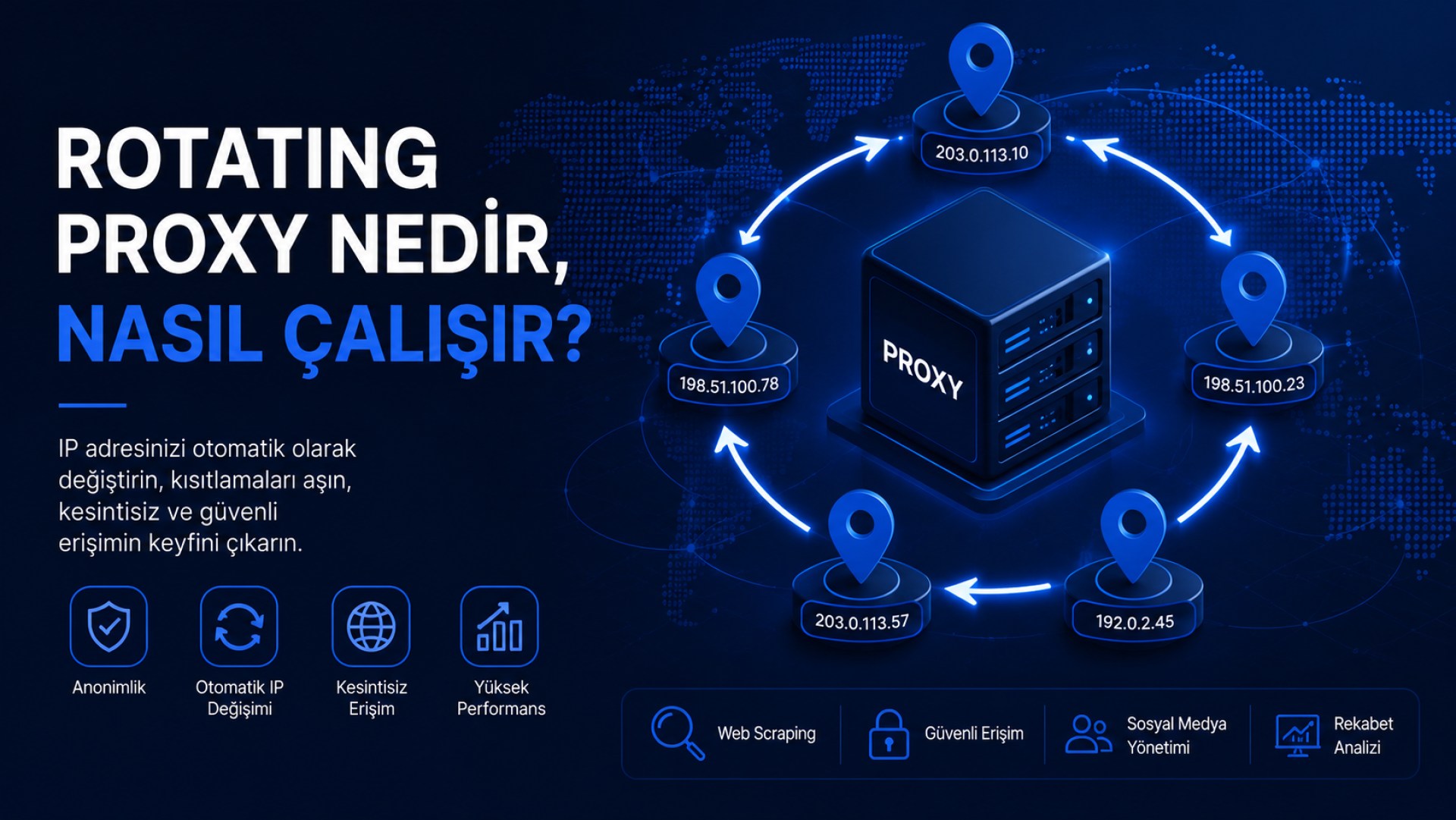
A rotating proxy is a proxy service that automatically changes the IP address on every connection request or at defined time intervals. A proxy (intermediary server) is the server that sits between the user and the target site; it routes traffic through its own IP address. LivaProxy offers this model with the Rotating IPv6 Proxy product, with prices starting at 1,250 TL. While a classic static proxy uses a single fixed IP, the rotating structure assigns different addresses in sequence from an IP pool.
A rotating proxy consists of two main components: an IP pool and a rotation logic that assigns IPs from this pool. In the LivaProxy product family, besides the IPv6 based rotating solution, there are also wide address block packages such as the /32 subnet IPv6 server starting at 4,250 TL. Address rotation aims to operate without being tied to a single IP in heavy request scenarios such as automation and data collection.
A rotating proxy works by mapping each incoming request to a new address selected from an IP pool. The user connects to a single proxy entry point (gateway); in the background, the system forwards the request to the target site through a different IP from the pool. This way, the target site sees consecutive requests as coming from many different addresses instead of a single source.
Rotation is performed with one of two methods. The first is per request rotation: the IP changes on each HTTP request. The second is time based rotation: the IP stays fixed for a defined period, then renews. LivaProxy mobile proxy products include an IP reset link and an automatic IP reset feature; the user can trigger the IP manually or have the system renew it automatically. At the connection layer, HTTP/HTTPS proxy and SOCKS5 protocols are supported.
Access authorization is managed with IP authorization (whitelist), the method of permitting predefined IPs. The user defines their own server or computer IP in the panel; only requests coming from this address can use the proxy. This structure relies on source IP verification instead of username and password.
A static proxy uses a single fixed IP address throughout the session. A rotating proxy changes the IP regularly. A fixed IP is preferred in operations that require session continuity (for example, situations where you need to stay tied to one account). A changing IP is used in automation and data collection scenarios that send many parallel requests.
A rotating proxy is used to distribute high volume and repeated network requests across different IPs. Data collection (web scraping), meaning the automatic extraction of data from web pages, is the most common use area. When thousands of requests are sent from a single IP, the target site can rate limit this traffic; rotation spreads the requests across many addresses.
Data collection and price tracking: automations that crawl many pages at regular intervals.
Social media management: managing multiple accounts with different IPs.
Ad verification: checking how ads appear from different locations and IPs.
Market research: collecting regional content and price differences.
Automation workflows: bot and script scenarios that produce heavy requests.
LivaProxy operates with a focus on providing Turkey based IPs. On the mobile proxy side, there are packages that provide a Turkey IP over carrier infrastructure; in 2026, the Bursa location went on sale for mobile proxy service. This local focus targets access and test scenarios that require a Turkey IP.
Rotating proxy is divided into different types based on the infrastructure source. Each type carries a different IP source and cost level. The table below shows the main proxy types in the LivaProxy product family with their starting prices.
Datacenter proxy starts at the lowest entry cost (50 TL); it uses data center sourced IPs. Mobile proxy, on the other hand, uses carrier IPs, so it is close to the behavior of a real mobile connection. The Rotating IPv6 structure, thanks to the wide IPv6 address space, can hold many unique addresses in its pool.
Rotating proxy selection rests on technical criteria such as the IP source, the rotation logic, and the protocol support. The type of IP pool (mobile, datacenter, ISP) is determined according to the target scenario. The form of rotation, that is whether it is per request or time based, should match the request frequency of the automation.
Protocol support is the second criterion. LivaProxy products include HTTP/HTTPS proxy and SOCKS5 support; SOCKS5 is a more general proxy protocol that can also carry non web traffic. The third criterion is access management: IP authorization (whitelist) and IP reset link determine how the IP is renewed and who can access it. In traffic based (GB) packages, monthly data volume also plays a role in the selection; mobile packages are offered in tiers such as 15GB and 30GB.
The most common misconception about rotating proxy is the assumption that the IP always changes per request. Rotation depends on the configuration; some setups renew the IP on a time basis, and some wait for a manual reset. The second misconception is the idea that a rotating proxy guarantees anonymity. A proxy only changes the source IP; browser fingerprint, cookies, and session data are separate layers.
The third common misconception is the assumption that all proxy types are the same. Datacenter, ISP, and mobile IPs come from different sources and are evaluated differently by target systems. Mobile proxy uses carrier IPs while datacenter proxy uses data center blocks; this difference is decisive in terms of cost and behavior.
A rotating proxy is a solution designed for users who generate heavy and repeated network requests. Teams that collect data, multi account social media managers, and developers who build automation are the main user group. LivaProxy targets this segment with a wide price range stretching from datacenter (50 TL) to the premium IPv6 server (4,250 TL).
In scenarios that require a Turkey IP, mobile proxy products stand out; they provide a local IP over carrier infrastructure and expand with location options including Bursa. In operations tied to a single account that require a fixed IP, a static proxy is more suitable; the rotating structure creates value when many parallel requests are needed. The decision is made based on request volume, IP source need, and budget.
This content is for informational purposes. Prices, package contents, and product features may change; verify current information from the official LivaProxy site before ordering.
A rotating proxy is a proxy service that automatically changes the IP address from a pool on every request or at defined intervals. The user connects to a single entry point, and the system distributes the requests across different IPs. LivaProxy offers this service with the Rotating IPv6 Proxy product at a starting price of 1,250 TL.
A rotating proxy maps the incoming request to an address selected from an IP pool and forwards it to the target site through that IP. Rotation can be per request or time based. In LivaProxy mobile products, IP renewal is managed with the IP reset link and automatic IP reset; HTTP/HTTPS and SOCKS5 are supported at the connection.
A static proxy uses a single fixed IP, while a rotating proxy changes the IP regularly. A fixed IP suits jobs that require session continuity. A changing IP is used in data collection and automation scenarios that send many parallel requests. The choice is made based on the IP continuity need of the operation.
A rotating proxy is used in jobs that produce high request volume such as data collection, price tracking, social media management, ad verification, and automation. By spreading requests across many IPs, it provides the ability to operate without being tied to a single address. LivaProxy works in these use cases with a focus on Turkey based IPs.
Rotating proxy is divided into datacenter, ISP, and mobile types based on the IP source. Datacenter IPs start at 50 TL, mobile proxy at 1,400 TL, and Rotating IPv6 at 1,250 TL. Each type carries a different IP source and cost; the choice is set based on the IP need of the target scenario.
