Sign In
Sign Up
Select Your Country
 Turkey (Türkçe)
 Worldwide (English)
Turkey (Türkçe)
Worldwide (English)
Turkey (Türkçe)
Worldwide (English)
Worldwide (English)
Turkey (Türkçe)
Worldwide (English)
Turkey (Türkçe)
Worldwide (English)
 WELCOME Kupon Kodunu Kullanarak İlk Siparişlerinize Özel %10 İndirim İmkanından Faydalanabilirsiniz.
An IPv6 proxy is an intermediary server service that routes internet traffic through IPv6 (Internet Protocol version 6, the sixth version of the internet's addressing system) addresses. LivaProxy offers this service as part of its Turkey based proxy product family at prices starting from 200 TL. The service supports HTTP/HTTPS and SOCKS5 protocols and is provided by LIVAPROXY YAZILIM TİCARET LİMİTED ŞİRKETİ through its own website with a self serve order model.
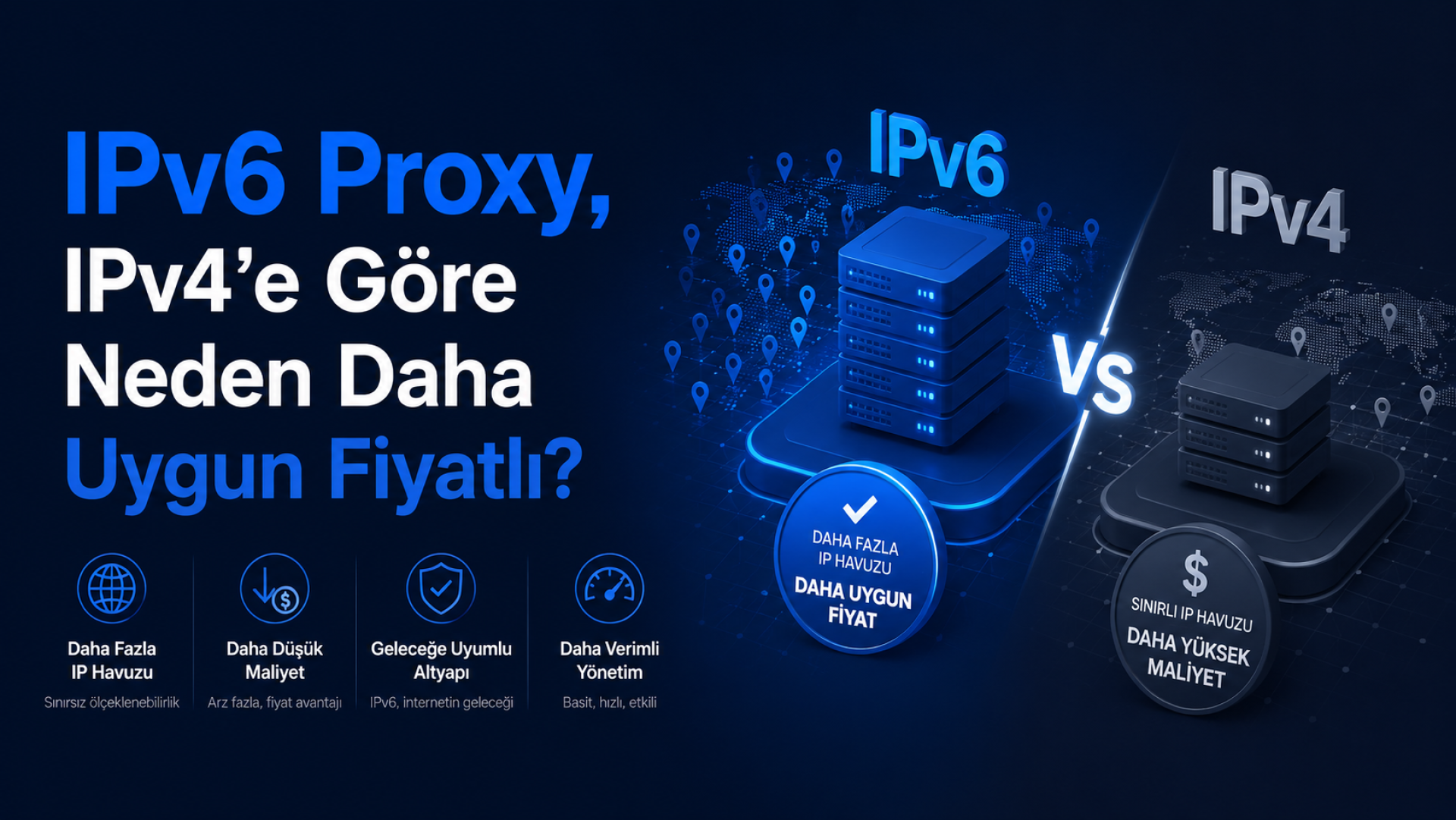
The IPv6 address space is much wider than IPv4 (Internet Protocol version 4, the fourth version of the addressing system). IPv4 is limited to about 4.3 billion addresses, while IPv6, with its 128 bit structure, brings the total number of addresses up to a practically inexhaustible pool. This structural difference is the technical basis for IPv6 proxy packages being listed in the LivaProxy catalog at a lower starting price than their IPv4 alternatives.
An IPv6 proxy forwards a user's requests to the target site through an IP address in IPv6 format. The client software connects to the proxy server, the server sends the request to the target with its own IPv6 address, and passes the response back to the user. In this process, the target site sees the IPv6 address of the proxy server as the source of the request, not the user's real address.
IP management in LivaProxy IPv6 products is handled with two methods: IP authorization (whitelist, the definition of permitted addresses) and manual or automatic IP reset. The Rotating IPv6 Proxy package starts from 1,250 TL and works with the logic of "a different IP on every request," meaning each network request sent picks up a new address from the pool. For customers who want static use there are single IPv6 packages, and for enterprise users who need large volumes there are subnet packages (a sub network, an address range allocated as a single block).
An IPv6 proxy price is lower than an IPv4 proxy price because the supply balance of the two addressing systems is different. The IPv4 address pool is limited to about 4.3 billion addresses and is largely exhausted, which makes each IPv4 address a scarce and costly resource. Because the IPv6 pool is practically unlimited, providers can offer IPv6 based packages at a lower unit cost.
This difference is reflected directly in prices in the LivaProxy catalog. While Datacenter IPv4 Proxy starts at 50 TL and ISP IPv4 Proxy starts at 100 TL, single IPv6 proxy packages do not carry scarce address pressure and so make high volume use more accessible. In bandwidth heavy automation and data collection scenarios where many concurrent addresses are needed, the breadth of the IPv6 pool turns into a cost advantage.
Address abundance also makes it possible to sell IPv6 packages on a subnet basis. The LivaProxy /48 Subnet IPv6 Proxy Server package starts at 1,500 TL, and the /32 Subnet IPv6 Proxy Server package starts at 4,250 TL. A /32 block contains an address range incomparably larger than a single IPv4 address, so the cost per unit address falls notably compared to IPv4.
IPv6 and IPv4 proxy packages diverge in the LivaProxy catalog in terms of starting price and usage model. The table below shows the starting prices published on the site in 2026 and the main attribute of each product at a glance.
The table shows that IPv4 packages have a cheaper entry for single and low count use, while IPv6 packages offer an advantage per unit address as volume grows and the subnet scale is reached. If a single address is enough, the IPv4 starting price is lower; if a wide address range is needed, the breadth of the pool balances out the cost.
An IPv6 proxy is suited for user segments that need many concurrent addresses. LivaProxy's defined target audience consists of individual and corporate customers who use social media management, gaming, data collection (web scraping, automated data extraction from sites), and automation. In these jobs, a wide address pool keeps the cost per IP low.
Data collection operations: a wide IPv6 pool offers a low cost per address for high request volumes.
Automation workflows: Rotating IPv6 Proxy provides a different IP on each request and supports concurrent operations.
Enterprise scale: the /48 and /32 subnet packages allocate a large address range in a single block.
Short term testing: the single IPv6 package, starting at 200 TL, suits trial scenarios.
The most common mistake in choosing an IPv6 proxy is comparing the price alone and ignoring the usage model. Buying a subnet package when a single address is enough creates unnecessary cost, while buying a single package when large volume is needed falls short. The second common mistake is buying without verifying the target platform's IPv6 support.
Selecting a package without calculating usage volume: decide first whether you need a single, rotating, or subnet package.
Not checking whether the target site accepts IPv6 traffic.
Not configuring IP reset and authorization settings after the order.
An IPv6 proxy stands out against IPv4 on cost in jobs that require a wide range and many addresses. In the LivaProxy catalog, single IPv4 packages are advantageous for single address use with a low entry starting at 50 TL, but as volume grows, the inexhaustible address pool of IPv6 brings the unit cost down. Data collection, automation, and enterprise scale operations are the natural use areas of IPv6.
The origin of the price difference is the supply balance: IPv4 is a scarce resource with about 4.3 billion addresses, while IPv6 is practically unlimited. The fact that the Rotating IPv6 package starts at 1,250 TL and the /32 subnet package starts at 4,250 TL shows that as scale grows, block based sales become more economical per address than purchasing single IPv4. For single and low count needs IPv4 stands out; for high volume and wide pool needs IPv6 stands out.
Prices and package contents may change; verify current information from the official LivaProxy site before purchase.
An IPv6 proxy is an intermediary server service that routes internet traffic through IPv6 (the sixth version of the internet's addressing system) addresses. LivaProxy offers this service at prices starting from 200 TL with HTTP/HTTPS and SOCKS5 protocol support. Thanks to its wide address pool, it is preferred in jobs that require many concurrent addresses.
An IPv6 proxy is cheaper because the IPv6 address pool is practically unlimited, while IPv4 is scarce with about 4.3 billion addresses. IPv4 addresses, as a scarce resource, are more costly. In the LivaProxy catalog, IPv6 based packages offer a low cost per address, especially as volume grows.
LivaProxy IPv6 proxy packages start at 200 TL. Rotating IPv6 Proxy starts at 1,250 TL, /48 Subnet IPv6 Proxy Server starts at 1,500 TL, and /32 Subnet IPv6 Proxy Server starts at 4,250 TL. For comparison, Datacenter IPv4 Proxy starts at 50 TL and ISP IPv4 Proxy starts at 100 TL.
An IPv6 proxy is suited for individual and corporate customers who use social media management, gaming, data collection, and automation. The wide address pool lowers the cost per address in jobs that require many concurrent requests. For enterprise scale, subnet packages allocate a large address range in a single block.
The choice depends on usage volume and the target platform's IPv6 support. For single and low count use, IPv4 is more affordable with its 50 TL starting entry. If a wide address range and high volume automation are needed, the breadth of the IPv6 pool balances the cost. Before purchase, you should verify that the target site accepts IPv6 traffic.
